
We are witnessing an era of increasing delivery pressure, where speed has become one of the dominant rules of product development. This trend is not limited to technology alone, it reflects everyday routines as well, sometimes without particular reason. Time-to time market has never been more emphasized or more critical. However, this acceleration comes at a price. For HW design, it means mainly relaying on of the shelf solutions and their adoption. Rushed hardware development often results in oversized design, reflecting to inefficient power consumption, more waste, unstable features, and design flaws that directly impact product cost and overall quality. All these changes even open the door to a broader reflection on whether our industry could benefit from more structured guidance or regulation in the future.
Modern hardware design requires cross-functional collaboration
Traditional hardware design had to evolve to meet modern demands while preserving its core strengths.
Today, hardware design services rely heavily on collaboration between multiple disciplines: software, mechanics, marketing, and purchasing. Bringing cross-functional teams together significantly accelerates end-to-end hardware design and development. This is exactly the model applied at ELSYS Eastern Europe, where ELSYS Eastern Europe (Hardware), AVISTO Eastern Europe (Software) and MECAGINE Eastern Europe (Mechanics) work closely to deliver sophisticated products.
Applying agile methodologies in hardware development
It was long believed that Agile methodologies could not be applied to hardware projects. This is no longer the case. At ELSYS Eastern Europe, Agile principles have been successfully integrated into hardware development for several years. Combined with Agile practices at higher levels of project management, this approach increases development pace and efficiency throughout the New Product Development (NPD) process.
Cost-aware hardware design and early engineering involvement
Another defining factor of this era is the evolution of the hardware designer toward a system-level engineer. Having hardware engineers with skills in software, mechanics, and even marketing has become a decisive advantage for rapid project bring-up. Equally important is the early involvement of hardware engineers during the project definition and marketing phases. This helps define realistic goals – not in terms of technical possibilities, which are often endless, but in terms of price and overall development cost, a key pillar of every successful startup and product strategy. This cost-aware hardware design approach helps clients reduce development risks, avoid unnecessary design iteration and optimize product cost from the earlies phases of development.
Hardware validation and testing in ELSYS Eastern Europe in-house labs
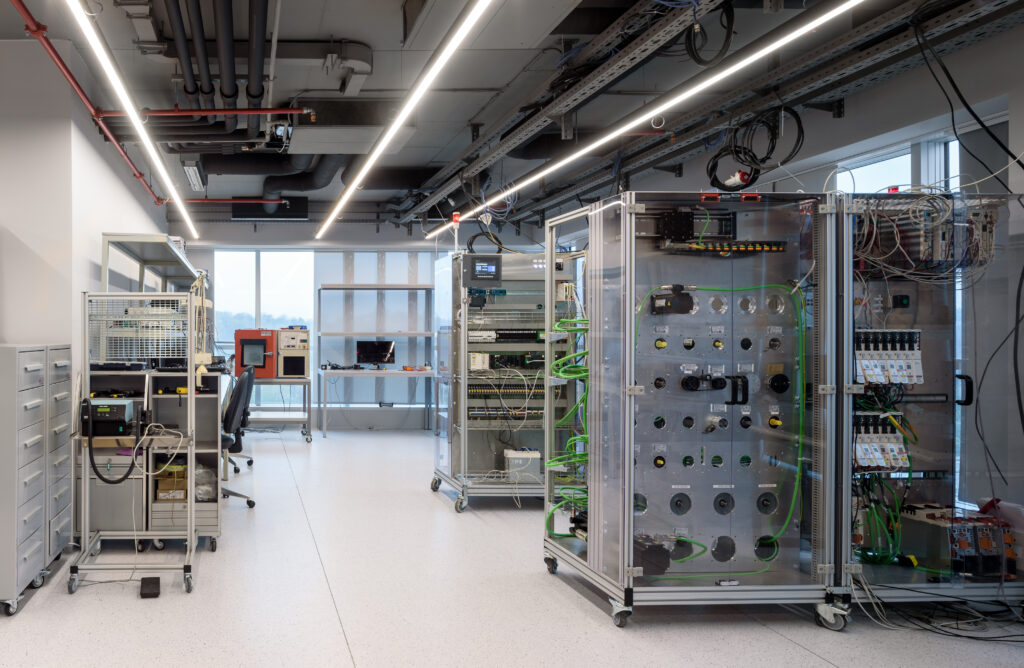
A well-equipped laboratory is essential for successful hardware development. At ELSYS Eastern Europe, hardware validation and testing are performed in-house using automated test tools capable of interacting with lab equipment such as oscilloscopes, electronic loads, and power supplies. This setup enables early detection of design issues, faster iterations, and higher confidence in product reliability before entering later development stages or production.
Compliance, standards and risk reduction in hardware projects
Depending on the application domain, hardware projects must comply with various safety and regulatory standards, often a time-consuming and critical phase of the project. At ELSYS Eastern Europe, this challenge is anticipated early trough continuous investment in knowledge and tools. EMI/EMC and thermal compliance, covering multiple UL and EMI standards, are available in-house within ELSYS laboratories, significantly shortening validation and certification timelines. With strong hardware design expertise, in-house validation laboratories, and a cost-aware engineering approach, ELSYS Eastern Europe supports clients throughout the complete hardware development lifecycle, from early concept definition to validated, production-ready designs.
Through the commitment of our teams and the continuous improvement of our practices, ELSYS Eastern Europe strengthens its expertise every day and enhances its ability to support even the most demanding projects.